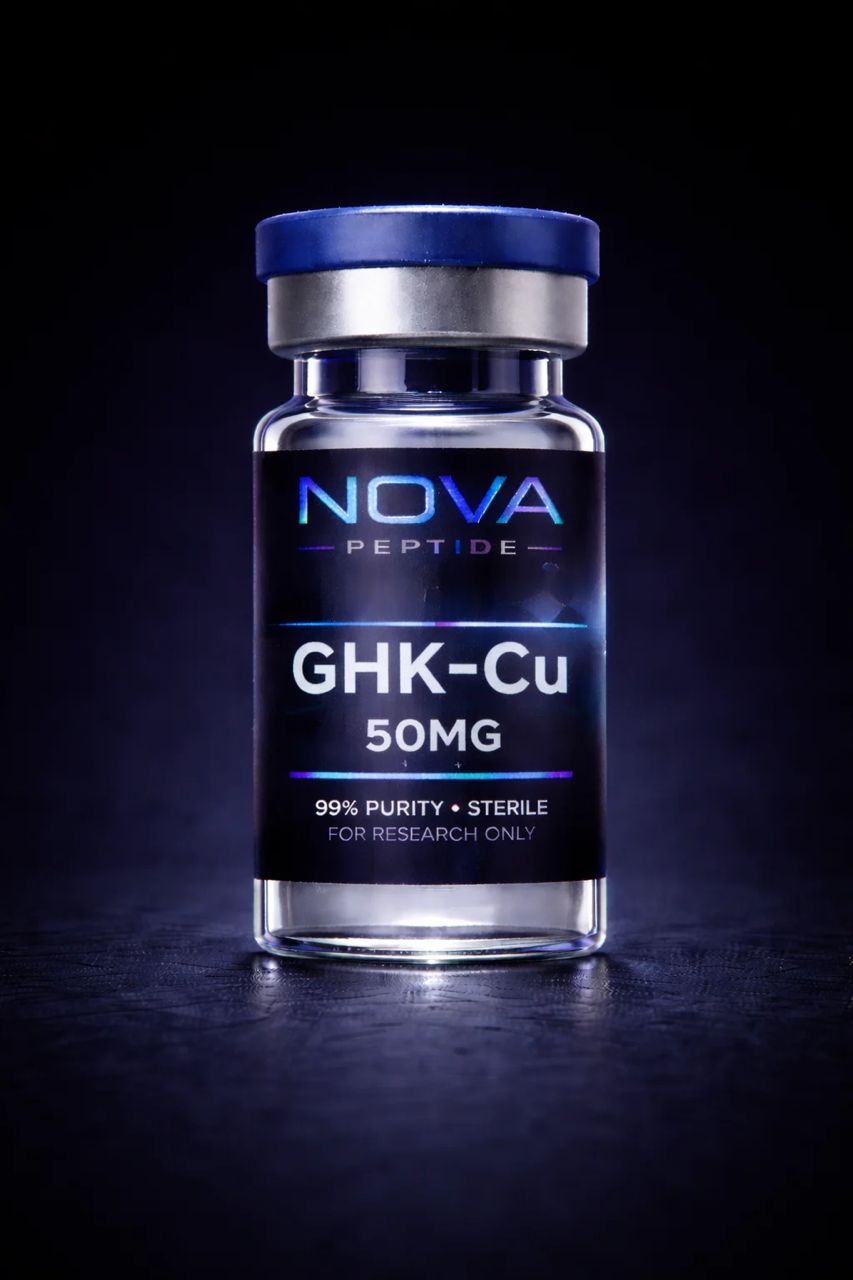
GHK-Cu 50mg – Copper Peptide Research Material
GHK-Cu peptide UK 50mg is a copper-binding peptide research material intended for laboratory, analytical and scientific research applications. Also known as GHK-Cu, Copper Tripeptide, or Glycyl-L-Histidyl-L-Lysine Copper, this peptide has attracted significant scientific interest because of its interaction with copper ions and its role in research investigating cellular signalling, peptide chemistry and extracellular-matrix biology.
Nova Peptide Lab provides GHK-Cu 50mg for research use only, offering researchers and qualified laboratory professionals access to a specialised peptide material for controlled scientific investigation.
GHK-Cu research has been explored across biochemical, molecular and cellular research settings. Scientific studies have examined its copper-binding characteristics, molecular interactions and biological activity in experimental models.
Important: This product is supplied strictly for laboratory research and analytical purposes. It is not intended for human or veterinary consumption, therapeutic use, diagnosis, or administration.
What Is GHK-Cu?
GHK-Cu is a copper-associated form of the tripeptide glycyl-L-histidyl-L-lysine (GHK). GHK has a strong affinity for copper and can form a copper complex known as GHK-Cu. Scientific literature has investigated the chemical behaviour, stability and biological interactions of this peptide-copper complex.
The compound is frequently referred to as copper peptide, copper tripeptide, or GHK copper peptide in scientific and research literature.
From a chemical research perspective, GHK-Cu is particularly interesting because the peptide ligand interacts with copper ions through coordination chemistry. Research has used techniques including spectrophotometry, calorimetry, potentiometry, circular dichroism and electron paramagnetic resonance to examine copper complexes involving GHK.
PubChem identifies GHK-Cu as copper tripeptide and provides molecular and structural information for the compound.
GHK-Cu at a glance
- Product: GHK-Cu 50mg
- Common name: Copper Tripeptide
- Peptide: Glycyl-L-Histidyl-L-Lysine
- Copper complex: GHK-Cu
- Category: Research peptide
- Quantity: 50mg
- Intended purpose: Laboratory and analytical research
- Human use: Not intended for human use
- Veterinary use: Not intended for veterinary use
- In-vivo administration: Not intended
GHK-Cu Research Applications
GHK-Cu is studied in a variety of laboratory and preclinical research areas. Its ability to interact with copper makes it relevant to researchers investigating peptide-metal interactions, cellular signalling, molecular biology and extracellular-matrix processes.
Research applications may include:
1. Peptide and Protein Research
GHK-Cu provides a useful research subject for laboratories investigating peptide structure, peptide-metal interactions and the behaviour of biologically relevant peptide complexes.
Researchers can examine characteristics such as:
- Peptide structure
- Copper coordination
- Molecular interactions
- Peptide stability
- Binding behaviour
- Chemical properties
- Experimental reaction pathways
2. Copper-Binding Research
One of the defining characteristics of GHK-Cu is its relationship with copper ions.
Researchers have investigated how GHK coordinates with copper and the resulting chemical properties of the complex. These studies contribute to broader research into metal-binding peptides and biological copper chemistry.
3. Cellular and Molecular Biology
GHK-Cu has also been investigated in experimental biological models examining cellular processes and signalling pathways.
This makes it relevant to laboratories conducting research into:
- Cellular communication
- Molecular signalling
- Peptide-mediated biological interactions
- Copper-dependent pathways
- Cell culture research
- Extracellular-matrix biology
4. Extracellular-Matrix Research
GHK and GHK-Cu have been investigated in relation to extracellular-matrix biology and tissue-related cellular processes.
This area of research is particularly relevant to scientists studying the interaction between peptides, cellular environments and extracellular components.
5. Biochemical Research
GHK-Cu can also be used as a research material in biochemical investigations involving peptide chemistry and copper-associated molecular systems.
Its defined peptide structure makes it suitable for controlled laboratory investigation where researchers require a specific copper-binding peptide for experimental work.
Potential Research Benefits of GHK-Cu
When discussing GHK-Cu scientifically, it is important to distinguish research observations from established clinical benefits.
Laboratory and preclinical studies have reported biological activity associated with GHK-Cu, but these findings should not be interpreted as evidence that the compound is a treatment for human disease or injury.
For research purposes, GHK-Cu offers several scientific characteristics that make it an interesting experimental compound:
- Defined peptide structure
- Copper-binding capability
- Relevance to peptide-metal chemistry
- Extensive preclinical research history
- Potential utility in cellular research models
- Relevance to extracellular-matrix studies
- Applicability to biochemical investigations
- Use as a subject for molecular signalling research
Published research has specifically examined GHK-copper complex formation and its chemical behaviour using multiple analytical techniques.
These characteristics make GHK-Cu 50mg research peptide a useful material for appropriately designed laboratory studies.
Why Researchers Study GHK-Cu
GHK-Cu occupies an interesting position at the intersection of peptide chemistry and copper biology.
Unlike a conventional small molecule, GHK-Cu involves a peptide ligand interacting with a metal ion. This provides researchers with an opportunity to investigate how peptide structure influences metal coordination and how copper-associated peptide complexes behave under different experimental conditions.
Scientific interest in GHK-Cu includes:
Copper Coordination
The interaction between GHK and copper can be investigated using analytical chemistry techniques to characterise complex formation and molecular behaviour.
Peptide Chemistry
GHK-Cu allows researchers to investigate a defined tripeptide system and its relationship with metal ions.
Cellular Signalling Research
Preclinical literature has investigated GHK and GHK-Cu in experimental biological systems, providing a basis for continued research into cellular and molecular mechanisms.
Extracellular-Matrix Biology
GHK is associated with research into extracellular-matrix processes, making GHK-Cu relevant to laboratories studying peptide interactions with cellular and extracellular environments.
Translational Research
Because GHK-Cu has been investigated in both biochemical and biological models, it remains a subject of continuing scientific interest. However, laboratory findings should not automatically be extrapolated to clinical applications.
GHK-Cu 50mg for Laboratory Research
The 50mg format provides researchers with a defined quantity of GHK-Cu research material for laboratory applications.
Depending on the approved research protocol, laboratories may investigate GHK-Cu using appropriate analytical or experimental methodologies.
Potential research environments include:
- Academic laboratories
- Biochemistry laboratories
- Pharmaceutical research
- Peptide research
- Molecular biology
- Cell biology
- Analytical chemistry
- Biotechnology research
- Materials and peptide science
Researchers should establish their own experimental protocols, analytical requirements and applicable institutional procedures before beginning research.
Why Choose Nova Peptide Lab?
Nova Peptide Lab is focused on providing research-oriented peptide materials with clear product identification and professional product presentation.
When selecting a research peptide supplier, researchers should consider more than simply the listed peptide name or quantity.
Important considerations include:
- Clear compound identification
- Transparent product specifications
- Appropriate research-use labelling
- Batch-level documentation where applicable
- Appropriate storage information
- Professional packaging
- Clear customer support
- Responsible handling information
At Nova Peptide Lab, the emphasis is on presenting peptide products as research materials rather than medicines or therapeutic products. GHK-Cu peptide UK
For researchers purchasing GHK-Cu online, clear documentation and product identification can help laboratories assess whether a material is appropriate for their intended experimental requirements.
Quality Assurance
Quality assurance is an important consideration when sourcing peptide research materials.
For GHK-Cu 50mg, researchers should evaluate available product documentation and verify that the material supplied corresponds with the stated product identity.
Depending on the batch and documentation available, relevant quality information may include:
- Product identity
- Batch or lot identification
- Stated quantity
- Analytical information
- Purity information where applicable
- Storage recommendations
- Handling information
Important: Customers should review the documentation supplied with their specific batch rather than assuming that analytical specifications are identical across different production lots.
Where a Certificate of Analysis (COA) or other batch documentation is supplied, researchers should retain the documentation as part of their laboratory records.
Safe Laboratory Handling
GHK-Cu should be handled as a laboratory research material by appropriately trained personnel.
Researchers should follow their institution’s applicable laboratory safety procedures, risk assessments and chemical-handling requirements.
General laboratory considerations include:
- Handle only in an appropriate laboratory environment.
- Follow applicable institutional safety procedures.
- Use suitable personal protective equipment.
- Avoid unnecessary exposure to laboratory materials.
- Keep the product appropriately labelled.
- Store according to the supplier’s product documentation.
- Keep research materials away from unauthorised users.
- Do not use the product for human or veterinary administration.
- Do not consume the product.
- Dispose of unused material according to applicable laboratory procedures.
Before conducting research, laboratories should review the product documentation and establish appropriate handling and storage procedures for their particular research environment.
GHK-Cu Research Peptide – UK and USA Availability
Nova Peptide Lab serves customers looking for GHK-Cu research peptides in the UK and international research markets.
For customers in the USA, USA shipping may be available, subject to current shipping options, destination restrictions and applicable import requirements.
International customers are responsible for ensuring that their purchase and intended research use comply with the laws, regulations and institutional requirements applicable in their location.
The availability of international shipping does not represent confirmation that a product is authorised for any particular use in a destination country.
GHK-Cu Frequently Asked Questions
What is GHK-Cu?
GHK-Cu is a copper-associated complex of the tripeptide glycyl-L-histidyl-L-lysine. It is also commonly called copper tripeptide or copper peptide and has been studied extensively in biochemical and preclinical research.
What is GHK-Cu 50mg?
GHK-Cu 50mg refers to a 50mg quantity of GHK-Cu research material. The product is supplied for laboratory and analytical research purposes. GHK-Cu peptide UK
What is GHK-Cu used for in research?
GHK-Cu can be investigated in peptide chemistry, copper-binding studies, molecular biology, cellular research, extracellular-matrix research and other controlled laboratory applications.
Is GHK-Cu a copper peptide?
Yes. GHK-Cu is commonly referred to as a copper peptide or copper tripeptide because the GHK peptide forms a complex with copper.
Is GHK-Cu a medicine?
This product is marketed by Nova Peptide Lab as a research-use-only material, not as a licensed medicine. UK medicines require appropriate marketing authorisation, and the MHRA states that unlicensed medicines have not received a UK marketing authorisation.
Can GHK-Cu be used by humans?
No. This product is supplied strictly for laboratory research and analytical purposes and is not intended for human consumption, therapeutic use, or administration.
Can GHK-Cu be used in clinical treatment?
No. This product should not be represented as a clinical treatment or as a substitute for an authorised medicinal product. GHK-Cu peptide UK
How should GHK-Cu be handled?
GHK-Cu should be handled by appropriately trained laboratory personnel following the applicable laboratory safety procedures, risk assessments and product documentation.
Research Use Only Disclaimer
GHK-Cu 50mg is supplied strictly for laboratory research and analytical purposes only.
This product is not intended for human or veterinary consumption, administration, diagnosis, treatment, prevention or mitigation of any disease or medical condition.
This product is not a dietary supplement, cosmetic treatment, pharmaceutical medicine or medical device.
Nothing on this page should be interpreted as medical advice or as a claim that GHK-Cu can diagnose, prevent, treat or cure any disease, injury or medical condition.
Researchers are responsible for determining the suitability of the material for their intended research application and for complying with all applicable laws, regulations, institutional policies and laboratory safety requirements.
Order GHK-Cu 50mg for Research
If you are sourcing GHK-Cu 50mg research peptide for legitimate laboratory or analytical work, Nova Peptide Lab provides a dedicated research-material option with clear product identification and research-use positioning. GHK-Cu peptide UK
Explore the GHK-Cu 50mg product listing and review the available product information before placing your order.
Order GHK-Cu 50mg today from Nova Peptide Lab for laboratory research and analytical applications.
Research use only. Not for human or veterinary use.
Reviews
There are no reviews yet.